
Loading mission resources...
Watch
Live coverage
Stream links and embedded coverage.
Drag, scroll, or use arrow keys.
Past below / Future above
Loading related news...
Launch Detail
Loading launch detail
Pulling launch timing, vehicle context, weather signals, and mission evidence.
Launch detail
China Aerospace Science and Technology Corporation • Long March 6A • Launch Complex 9A (NA)
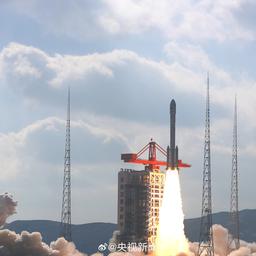
China Aerospace Science and Technology Corporation • Long March 6A • LC-9A
18 Low Earth Orbit communication satellites with Ku, Q and V band payloads for the G60 constellation operated by Shanghai Spacecom Satellite Technology (SSST) with funding backed by the Shanghai local government. Initial constellation will consist of 1296 satellites by 2027 with long term plans to expand it to 12000 satellites.
Stream links and embedded coverage.
Open the launch pad in Google Maps satellite mode using the pad coordinates.
18 Low Earth Orbit communication satellites with Ku, Q and V band payloads for the G60 constellation operated by Shanghai Spacecom Satellite Technology (SSST) with funding backed by the Shanghai local government. Initial constellation will consist of 1296 satellites by 2027 with long term plans to expand it to 12000 satellites.
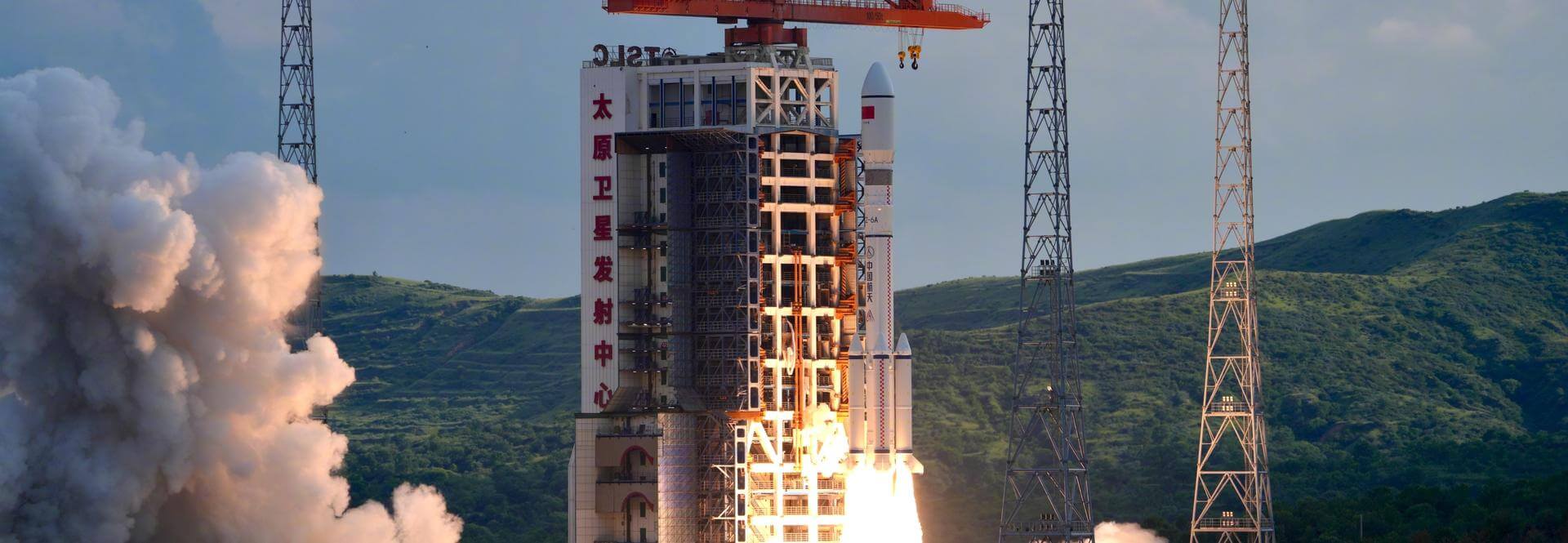
The Long March 6A is a Chinese launch vehicle of the Long March family, which was developed by the China Aerospace Science and Technology Corporation (CASC) and the Shanghai Academy of Spaceflight Technology (SAST). The vehicle is a further development of the Long March 6, with 2 YF-100 engines on the first stage as opposed to 1 on the Long March 6, augmented by 4 solid rocket boosters. The Long March 6A is China's first rocket with solid rocket boosters. The maiden launch of the Long March 6A took place 29 March 2022, successfully reaching orbit. It was also the first launch from the newly built launch complex 9A in Taiyuan.
The China Aerospace Science and Technology Corporation (CASC) is the main contractor for the Chinese space program. It is state-owned and has a number of subordinate entities which design, develop and manufacture a range of spacecraft, launch vehicles, strategic and tactical missile systems, and ground equipment. It was officially established in July 1999 as part of a Chinese government reform drive, having previously been one part of the former China Aerospace Corporation. Various incarnations of the program date back to 1956.
40a7596aa44dd99374a5184d029fb7b04abb8a8231e96ec02993b38fb19d9b22Premium keeps the launch-by-launch change log visible so you can review slips, window edits, and status changes without waiting for an error-driven upgrade prompt.
Linked via Spaceflight News API (SNAPI).
 Article
In late November, two new Chinese rockets took their maiden flights within four days of… The post Chang Zheng 12, ZhuQue-2E fly maiden missions; Hainan spac...
 Article
HELSINKI — China launched the third batch of 18 satellites for the Thousand Sails constellation late Tuesday as the firm behind the project aims for global s...
 Article
This week is set to be a busy one in the world of spaceflight, with… The post Launch Roundup: Sentinel 1C and PROBA 3 among ten planned launches appeared fi...
Provider, rocket, pad, and booster history tied to this launch.