

Loading photos...
Loading mission resources...
Loading related events...
Loading vehicle timeline...
Loading related news...
TMinusZero
Loading
Preparing the latest launch data.
Launch Detail
Loading launch detail
Pulling launch timing, vehicle context, weather signals, and mission evidence.
Launch detail
Orbital Sciences Corporation • Pegasus • Edwards Air Force Base (NA)
Top answer
APEX (Advanced Photovoltaic & Electronic Experiment) successfully tested a wide array of advanced photovoltaic and electronic components in a harsh radiation environment, provided significant data to support improved designs for future space systems. During operation, APEX's highly elliptical orbit allowed the investigation of space plasma effects on high-voltage operation (current leakage at positive voltages and...
Last refreshed: Jun 13, 2023, 11:57 PM EDT. T-Minus Zero keeps this as the canonical launch record and reconciles schedule, mission, payload, media, and provider signals when those records are available.
Alternate mission URLs consolidate to this canonical launch record so exact mission timing, status, media, and source context stay on one page.
Premium keeps the launch-by-launch change log visible so you can review slips, window edits, and status changes without waiting for an error-driven upgrade prompt.
Free-to-share photography matched to this launch. Tap a photo to view it at full resolution.
APEX (Advanced Photovoltaic & Electronic Experiment) successfully tested a wide array of advanced photovoltaic and electronic components in a harsh radiation environment, provided significant data to support improved designs for future space systems. During operation, APEX's highly elliptical orbit allowed the investigation of space plasma effects on high-voltage operation (current leakage at positive voltages and arcing at negative voltages) in the perigee region, plus the investigation of space radiation effects (decreased array power output from passage through the inner radiation belt) in the apogee region.
Use these internal paths to move from this exact launch record into the provider, vehicle, launch-site, schedule, and mission-family pages that own broader context.
This launch currently has no dedicated mission-family hub, so provider, vehicle, site, and canonical record links are the primary internal paths.
Key structured fields for this launch record are grouped here so the page answers mission, payload, orbit, provider, source, and timing questions before the deeper tracking and media sections.
This record is preserved as historical launch context. The page emphasizes what was launched, the vehicle and pad involved, published outcome/status fields, linked programs, and source records instead of treating the mission like an upcoming countdown.
Open the launch pad in Google Maps satellite mode using the pad coordinates.
APEX (Advanced Photovoltaic & Electronic Experiment) successfully tested a wide array of advanced photovoltaic and electronic components in a harsh radiation environment, provided significant data to support improved designs for future space systems. During operation, APEX's highly elliptical orbit allowed the investigation of space plasma effects on high-voltage operation (current leakage at positive voltages and arcing at negative voltages) in the perigee region, plus the investigation of space radiation effects (decreased array power output from passage through the inner radiation belt) in the apogee region.
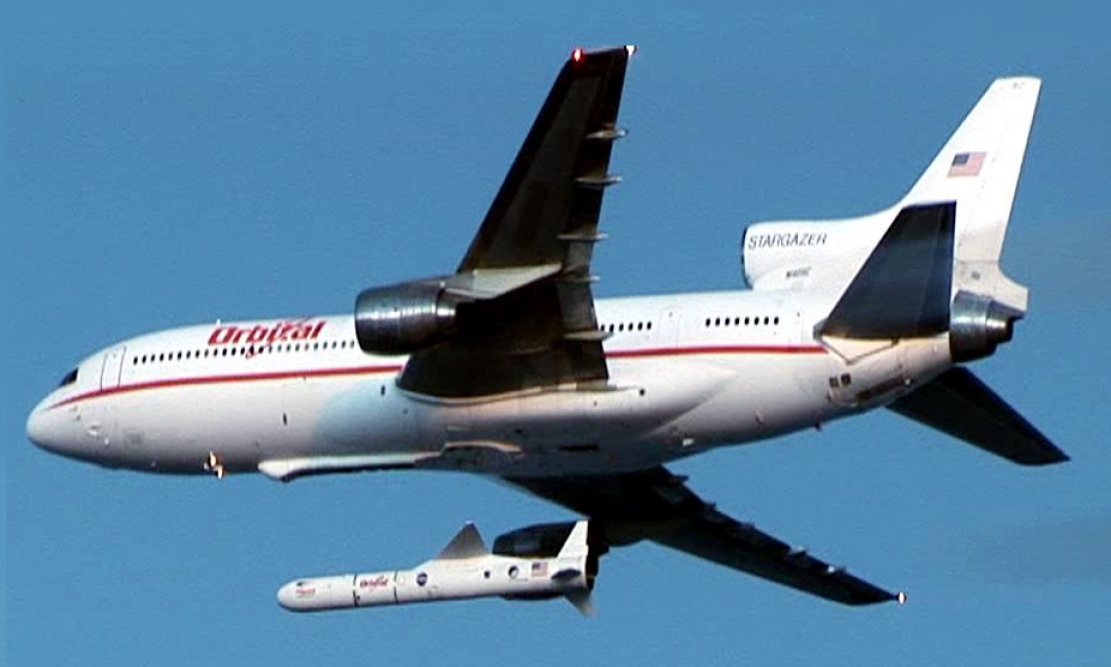
The Pegasus is an air-launched rocket developed by Orbital Sciences Corporation (now part of Northrop Grumman Innovation Systems). Capable of carrying small payloads of up to 443 kilograms (977 lb) into low Earth orbit, the vehicle consists of three solid propellant stages and an optional monopropellant fourth stage. Pegasus is released from its carrier aircraft at approximately 40,000 ft (12,000 m), and its first stage has a wing and a tail to provide lift and attitude control while in the atmosphere.
334724f5c0f755c005a44027e41832549104cda496da993339e2ce234a46cbaaProvider, rocket, pad, and booster history tied to this launch.