Soyuz TM-14
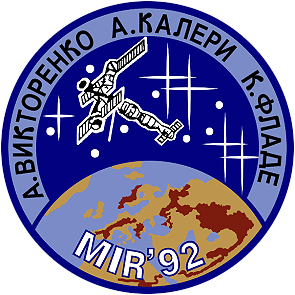
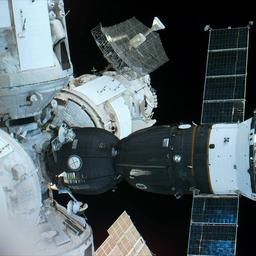
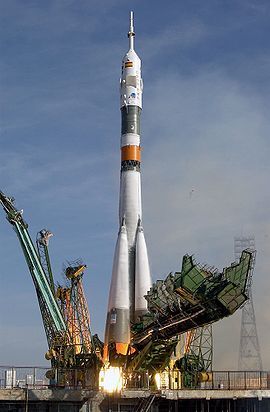
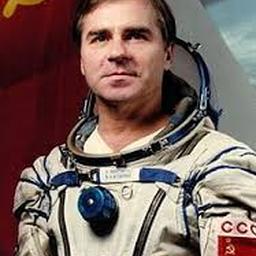
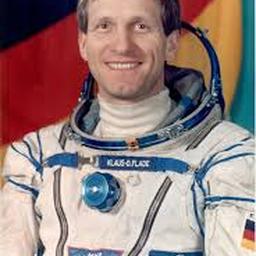
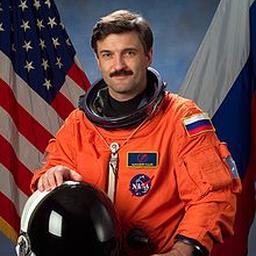
Soyuz TM-14 was the 14th mission and the 11th long-duration expedition to Mir space station. It was the first mission after the USSR collapsed, and so became the first Russian space flight. The mission began on March 17, 1992, 10:54:30 UTC, launching Commander Alexander Viktorenko, Flight Engineer Alexander Kaleri and Research Cosmonaut Klaus-Dietrich Flade into orbit. They docked with Mir two days later. During their stay there, cosmonauts performed an EVA, various station repair and maintenance tasks, and carried out scientific experiments in materials research, space technology, astrophysics and earth observation. They were visited by several Progress resupply spacecrafts, and welcomed aboard the Soyuz TM-15 crew. The mission concluded with a safe landing back on Earth on August 10, 1992, 01:05:02 UTC.
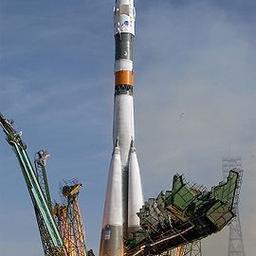
The Soyuz-U2 was a Soviet, later Russian, carrier rocket. It was derived from the Soyuz-U, and a member of the R-7 family of rockets. It featured increased performance compared with the baseline Soyuz-U, due to the use of syntin propellant, as opposed to RP-1 paraffin, used on the Soyuz-U.
Service provider
Government • RUS
The Roscosmos State Corporation for Space Activities, commonly known as Roscosmos, is the governmental body responsible for the space science program of the Russian Federation and general aerospace research. Soyuz has many launch locations the Russian sites are Baikonur, Plesetsk and Vostochny however Ariane also purchases the vehicle and launches it from French Guiana.
Objects from this launch
0 objects
SATCAT inventory for 1992-014
Catalog is not available yet for this launch.
Last success: 2026-02-01T11:15:02.073+00:00
LL2 payloads: 0SATCAT payloads: 0Delta: 0RB: 0DEB: 0UNK: 0