
Story 7 of 7 · 5 min reading · 2–4 min exploring
Pick a launch. Tell its story.
Four questions to get you started.
Explore the current schedule
A launch listing can be a collection of unfamiliar names. Pick out the rocket, its payload, its purpose, its starting point and its planned time, and a story begins to emerge. Here is one you can use as a model.
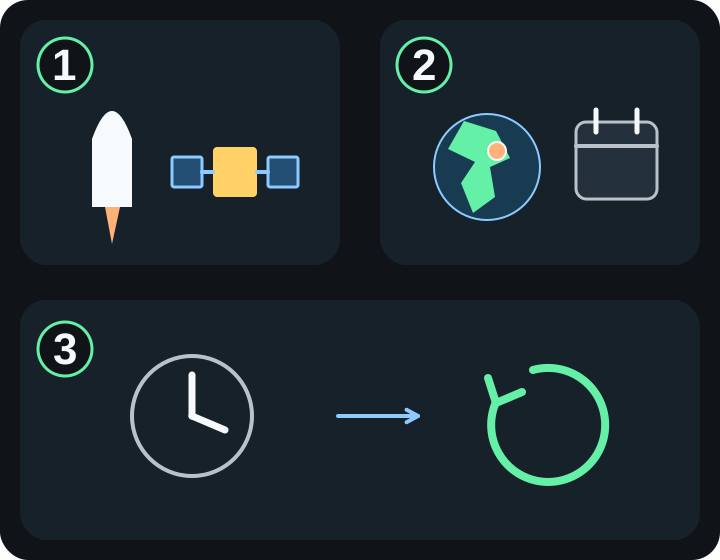
A mission-reading diagram with a rocket next to its payload, a globe marking a launch site, and a calendar beside a clock. A final refresh arrow means check the current status again. It contains no invented mission name, launch time or live status.
1 · Find the rocket and what it carries.
2 · Find the launch site, date and time zone.
3 · Read the status and check for a changed plan.
Start with a finished example
“Ariane 5 launched the James Webb Space Telescope from French Guiana on December 25, 2021. Webb traveled folded, then opened and prepared its infrared instruments to study the universe.”
The rocket was Ariane 5. Its payload was Webb. The purpose was astronomy; the launch site was in French Guiana. The date belongs to a completed flight.
Use the same four questions
What is launching, and what does it carry?
What will the mission do?
Where will it launch?
When is it planned, and how certain is that time?
Try it for yourself
Choose your mission
Pick a mission you want to understand. Use its details to tell someone what is launching, why it matters, and what you want to find out next.
Choose a launch in Today and open its details. Look in Mission for the rocket, payload and purpose, and Launch Time for the plan. If the schedule is unavailable, use the complete Webb example below.
Choose your missionBuild your own mission note
Start with any detail that interests you. Every field is optional; you can also think it through or tell someone aloud. These are temporary notes, kept while this reader stays loaded. They are not saved to your account and may disappear when the app or page reloads.
A complete example
Ariane 5 launched Webb from French Guiana on December 25, 2021. Webb studies the universe in infrared light. I want to find out how the folded telescope opened after launch.
Leave room for what is unknown
The payload is what the rocket carries for the mission. Some spacecraft are also satellites. Some test flights carry no separate customer payload. If a field is empty, look for confirmation in the mission description before saying there is no payload or crew.
Keep the displayed time zone with the date. A month is not an exact day, and NET means “no earlier than.” Use “not found in this listing” when a detail is missing. Use “not announced” only when the mission information says it has not been announced.
Find the detail that changes the story
From your chosen launch, explore its payload, spacecraft or related news in the app. Look for one detail that makes the flight more interesting: something that unfolds, a booster returning, or an instrument answering a new question.
Note the page or report where you found it and its date, when shown. A planned return is different from a completed landing. If you cannot confirm a detail, keep it as a question. For Webb, the NASA news summary below follows the telescope from launch to discovery.
Use the facts you found to explain the mission in a sentence or two. Add the detail that interested you most, and leave anything you could not confirm as a question.
FROM THE MISSION
The Launch of the James Webb Space Telescope
Completed mission example · Webb · December 25, 2021
What to notice
Try your four questions on this example: what launched and what did it carry, why did it fly, where did it launch, and when? Keep the date in your summary so nobody mistakes this archive for an upcoming flight.
Video: NASA / James Webb Space Telescope
NASA’s Webb channel shows Ariane 5 launching the James Webb Space Telescope from French Guiana on December 25, 2021. This is the completed flight used in our worked example.
Original on NASA ↗ (opens in a new tab)Three things to remember
- Identify the rocket, what it carries and what the mission will do.
- Read the date, time zone and current status together.
- Say what is unknown, and check again when the plan changes.
Keep exploring
A complete historical example if the live schedule is unavailable.
Explore another subject in any order.
In the news
NASA · Published
NASA’s Webb Reveals Dynamic Panorama of Star Formation
Years after Webb’s launch, its infrared observations of IC 348 helped researchers identify extremely low-mass brown dwarfs. A mission’s launch date and the publication date of a new discovery mark different parts of its story.
Open mission and related coverage