

Loading photos...
Loading mission resources...
Loading related events...
Loading vehicle timeline...
Loading related news...
TMinusZero
Loading
Preparing the latest launch data.
Launch Detail
Loading launch detail
Pulling launch timing, vehicle context, weather signals, and mission evidence.
Launch detail
Japan Aerospace Exploration Agency • Epsilon S • Mu Center (JP-46)
Top answer
SOLAR-C is a Japan-led international mission with the cooperation by the US and European countries. It aims to gain new insights into the fundamental physical mechanisms driving solar plasma dynamics by performing three simultaneous UV observations. The first consists to observe the broad range of temperatures, spanning over three orders of magnitude from the 10,000 Kelvin chromosphere to the million Kelvin corona...
Last refreshed: Feb 14, 2025, 6:59 PM GMT+9. T-Minus Zero keeps this as the canonical launch record and reconciles schedule, mission, payload, media, and provider signals when those records are available.
Premium keeps the launch-by-launch change log visible so you can review slips, window edits, and status changes without waiting for an error-driven upgrade prompt.
Free-to-share photography matched to this launch. Tap a photo to view it at full resolution.
SOLAR-C is a Japan-led international mission with the cooperation by the US and European countries. It aims to gain new insights into the fundamental physical mechanisms driving solar plasma dynamics by performing three simultaneous UV observations. The first consists to observe the broad range of temperatures, spanning over three orders of magnitude from the 10,000 Kelvin chromosphere to the million Kelvin corona, and even to the 15 million Kelvin solar flares. The second consists to resolve the elemental structures at high spatial (0.4 arcsec) and temporal (1 sec) resolution and trace their evolutions by increasing the ability to collect the solar UV rays 10 to 30 times as much as before. The third consists to conduct a high dispersion spectroscopy (equivalent to a velocity resolution of 2 km/s) to obtain spectroscopic information that enables quantitative diagnostics (such as velocity, temperature, density, ionization degree, and abundance). By combining the three observations, SOLAR-C can analyze the dynamically evolving solar atmospheres over a wide altitude range from the chromosphere to the corona while resolving elemental structures.
Alternate mission URLs consolidate to this canonical launch record so exact mission timing, status, media, and source context stay on one page.
Use these internal paths to move from this exact launch record into the provider, vehicle, launch-site, schedule, and mission-family pages that own broader context.
This launch currently has no dedicated mission-family hub, so provider, vehicle, site, and canonical record links are the primary internal paths.
Key structured fields for this launch record are grouped here so the page answers mission, payload, orbit, provider, source, and timing questions before the deeper tracking and media sections.
Open the launch pad in Google Maps satellite mode using the pad coordinates.
SOLAR-C is a Japan-led international mission with the cooperation by the US and European countries. It aims to gain new insights into the fundamental physical mechanisms driving solar plasma dynamics by performing three simultaneous UV observations. The first consists to observe the broad range of temperatures, spanning over three orders of magnitude from the 10,000 Kelvin chromosphere to the million Kelvin corona, and even to the 15 million Kelvin solar flares. The second consists to resolve the elemental structures at high spatial (0.4 arcsec) and temporal (1 sec) resolution and trace their evolutions by increasing the ability to collect the solar UV rays 10 to 30 times as much as before. The third consists to conduct a high dispersion spectroscopy (equivalent to a velocity resolution of 2 km/s) to obtain spectroscopic information that enables quantitative diagnostics (such as velocity, temperature, density, ionization degree, and abundance). By combining the three observations, SOLAR-C can analyze the dynamically evolving solar atmospheres over a wide altitude range from the chromosphere to the corona while resolving elemental structures.
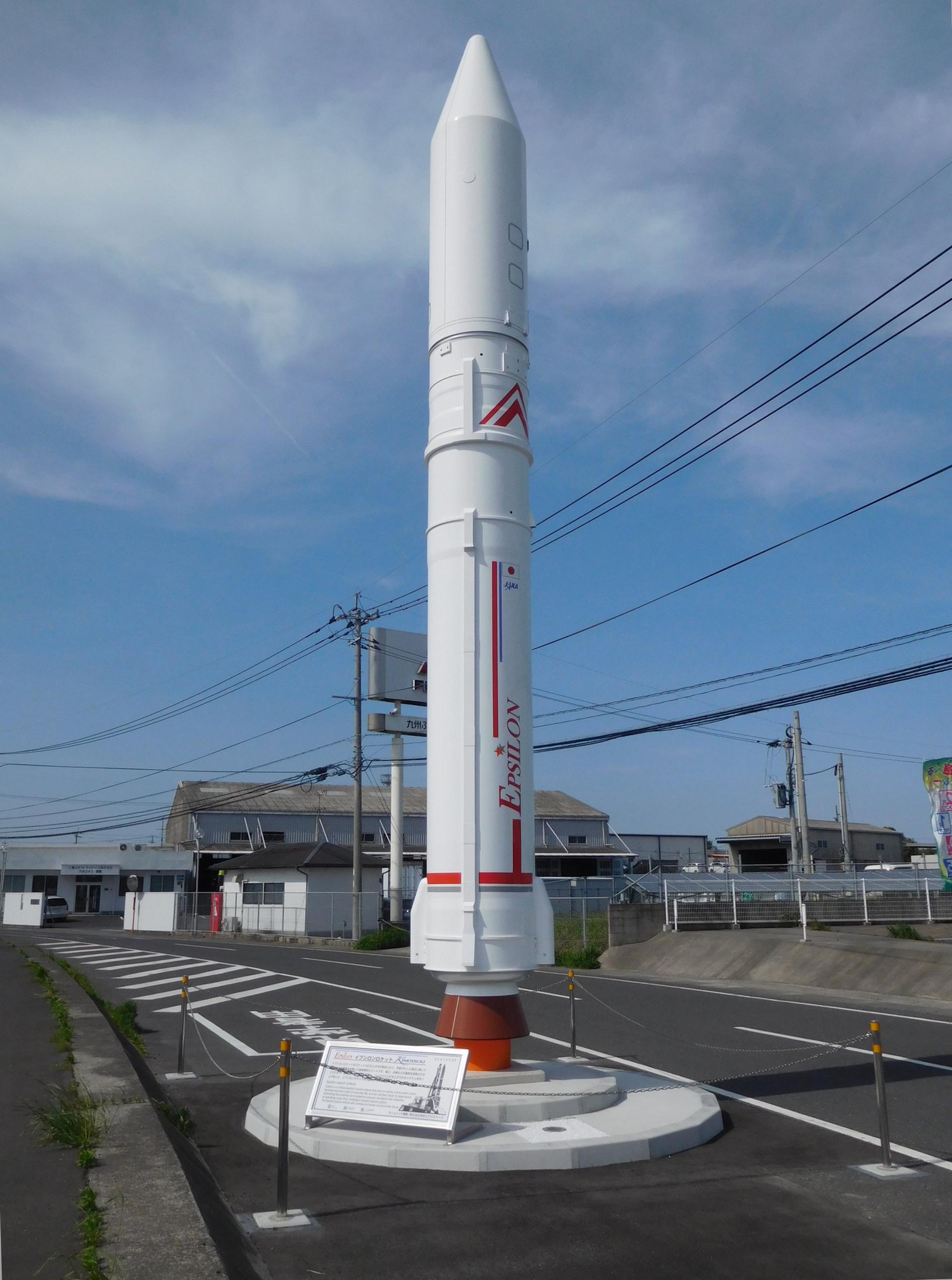
The Epsilon S rocket is a Japanese solid-fuel rocket designed to launch scientific satellites. It is a follow-on project to the larger and more expensive M-V rocket which was retired in 2006. The Japan Aerospace Exploration Agency (JAXA) began developing the Epsilon in 2007. The first stage is based on SRB-3, the strap-on solid-rocket booster of H3
The Japan Aerospace Exploration Agency (JAXA) is Japan's national aero-space agency. Through the merger of three previously independent organizations, JAXA was formed on 1 October 2003. JAXA is responsible for research, technology development and the launch of satellites into orbit, and is involved in many more advanced missions, such as asteroid exploration and possible manned exploration of the Moon. JAXA launch their Epsilon vehicle from the Uchinoura Space Center and their H-II vehicles from the Tanegashima Space Center.
Payload and object details are usually published 1–2 days after launch.
Provider, rocket, pad, and booster history tied to this launch.