
Loading photos...
Loading mission resources...
Loading related events...
Loading vehicle timeline...
Loading related news...
TMinusZero
Loading
Preparing the latest launch data.
Launch Detail
Loading launch detail
Pulling launch timing, vehicle context, weather signals, and mission evidence.
Launch detail
Khrunichev State Research and Production Space Center • Proton-K/DM-2M • 81/23 (81L) (KZ-43)

Khrunichev State Research and Production Space Center • Proton-K/DM-2M • 81/23 (81L)
Top answer
Echsostar 4 should have replaced EchoStar 1 at 119°W which would then have moved to 148°W (where only 24 transponders have been granted to EchoStar). After launch, the satellite has experienced anomalies in connection with solar panel deployment (two of five panels on one solar array have not unfolded). Therfore several transponders are not operational, so EchoStar 4 did not replace EchoStar 1. In Jul 1999 further...
Last refreshed: Jun 14, 2023, 8:46 AM GMT+5. T-Minus Zero keeps this as the canonical launch record and reconciles schedule, mission, payload, media, and provider signals when those records are available.
Premium keeps the launch-by-launch change log visible so you can review slips, window edits, and status changes without waiting for an error-driven upgrade prompt.
Free-to-share photography matched to this launch. Tap a photo to view it at full resolution.
Echsostar 4 should have replaced EchoStar 1 at 119°W which would then have moved to 148°W (where only 24 transponders have been granted to EchoStar). After launch, the satellite has experienced anomalies in connection with solar panel deployment (two of five panels on one solar array have not unfolded). Therfore several transponders are not operational, so EchoStar 4 did not replace EchoStar 1. In Jul 1999 further anomalies with thermal control and fuel systems were reported. Only 16 transponders are reported to be operational. EchoStar has filled for constructive total loss of the satellite, which was insured for $220 million. In Jun 1999 the FCC approved a move request to 110°W to allow EchoStar to start broadcasting from there. Earlier the FCC granted to transfer of the 110°W licence of MCI to EchoStar. During May 1999, EchoStar IV experienced anomalies affecting transponders, heating systems and the fuel system. In July 1999, additional fuel system anomalies were confirmed. By 31 October 2000, a total of 26 transponders of 44 aboard failed and by 30 June 2002, 38 transponders had failed. Only six transponders were available for use at this time. Currently the satellite functions as an in-orbit spare. In September 2004, the jammed solar array deployed spontaneously.
Alternate mission URLs consolidate to this canonical launch record so exact mission timing, status, media, and source context stay on one page.
Use these internal paths to move from this exact launch record into the provider, vehicle, launch-site, schedule, and mission-family pages that own broader context.
This launch currently has no dedicated mission-family hub, so provider, vehicle, site, and canonical record links are the primary internal paths.
Some high-demand launch records carry specialized search intent. These profiles explain what can be verified from the published record without filling gaps that upstream sources have not published.
Payload and orbit evidence is shown from published launch, payload, mission, and source-link records so the page can answer spacecraft, customer, orbit, provider, and schedule intent.
Key structured fields for this launch record are grouped here so the page answers mission, payload, orbit, provider, source, and timing questions before the deeper tracking and media sections.
This record is preserved as historical launch context. The page emphasizes what was launched, the vehicle and pad involved, published outcome/status fields, linked programs, and source records instead of treating the mission like an upcoming countdown.
Open the launch pad in Google Maps satellite mode using the pad coordinates.
Echsostar 4 should have replaced EchoStar 1 at 119°W which would then have moved to 148°W (where only 24 transponders have been granted to EchoStar). After launch, the satellite has experienced anomalies in connection with solar panel deployment (two of five panels on one solar array have not unfolded). Therfore several transponders are not operational, so EchoStar 4 did not replace EchoStar 1. In Jul 1999 further anomalies with thermal control and fuel systems were reported. Only 16 transponders are reported to be operational. EchoStar has filled for constructive total loss of the satellite, which was insured for $220 million. In Jun 1999 the FCC approved a move request to 110°W to allow EchoStar to start broadcasting from there. Earlier the FCC granted to transfer of the 110°W licence of MCI to EchoStar. During May 1999, EchoStar IV experienced anomalies affecting transponders, heating systems and the fuel system. In July 1999, additional fuel system anomalies were confirmed. By 31 October 2000, a total of 26 transponders of 44 aboard failed and by 30 June 2002, 38 transponders had failed. Only six transponders were available for use at this time. Currently the satellite functions as an in-orbit spare. In September 2004, the jammed solar array deployed spontaneously.
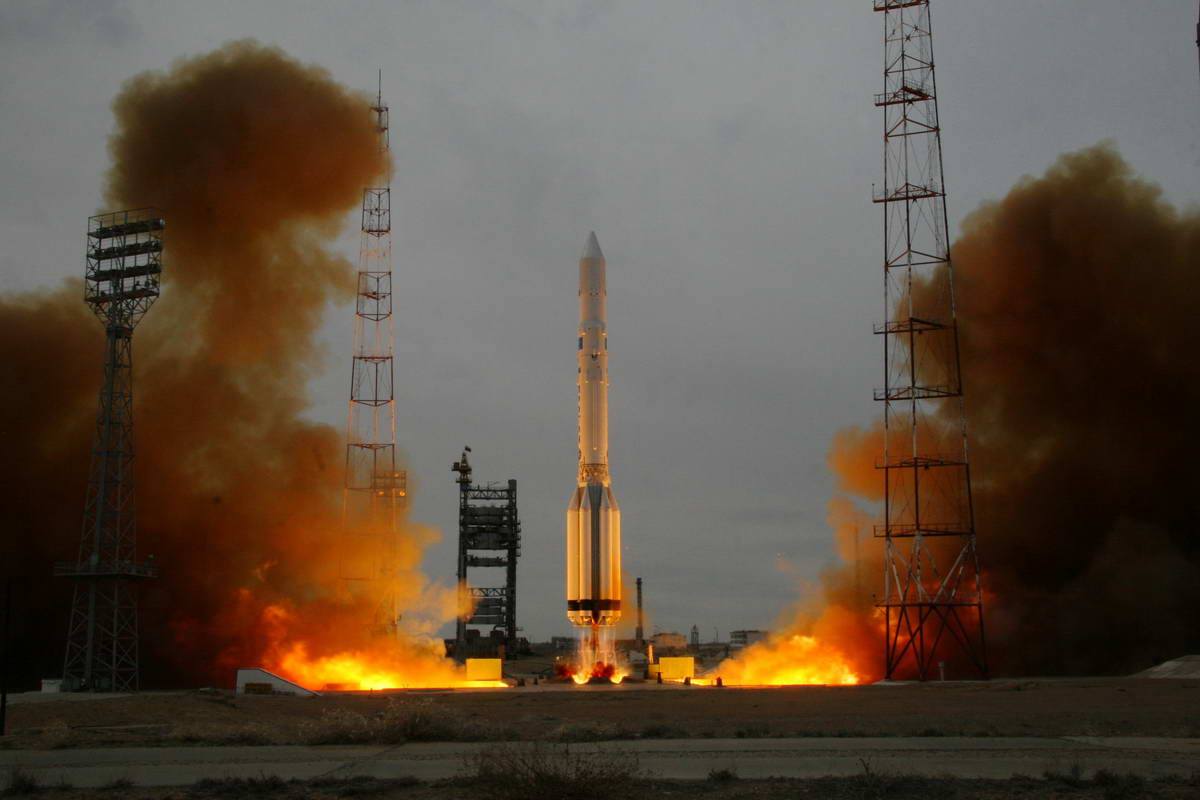
The Proton-K was a Russian, previously Soviet, carrier rocket derived from the earlier Proton. It was built by Khrunichev, and launched from sites 81 and 200 at the Baikonur Cosmodrome in Kazakhstan.
Khrunichev State Research and Production Space Center is a Moscow-based producer of spacecraft and space-launch systems, including the Proton and Rokot rockets and is currently developing the Angara rocket family. The Proton launch vehicle launches from Baikonur and Rokot launches from Baikonur and Plesetsk. Angara will launch from Plesetsk and Vostochny.
df9507dcb6bb364d586daae9c70530442ac527354e413fa68f919f2d0d54a650Provider, rocket, pad, and booster history tied to this launch.