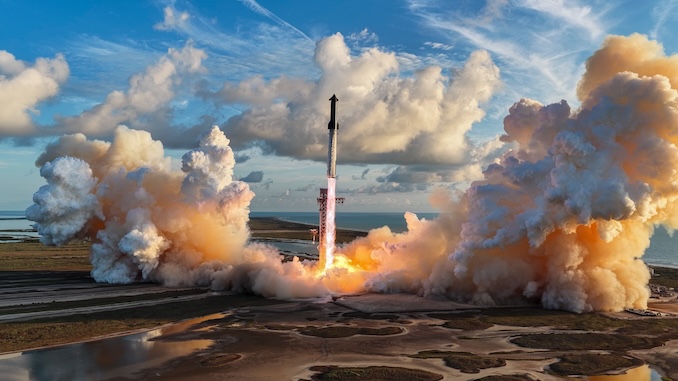
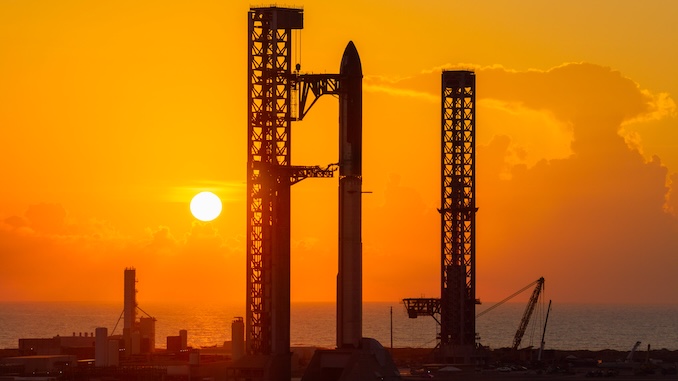
Ship 41
Third V3 Starship to fly with various enhancements, to be used on the 14th Starship test flight, the first Starship flight to deploy satellites into stable Low Earth Orbit. Lost in an explosion just after the soft splashdown.
TMinusZero
Loading
Preparing the latest launch data.
Launch Detail
Loading launch detail
Pulling launch timing, vehicle context, weather signals, and mission evidence.
Launch detail
SpaceX • Starship V3 • Orbital Launch Pad 2 (TX)
Top answer
14th test flight of the two-stage Starship launch vehicle. 3rd flight of Starship V3 and the first Starship flight to deploy satellites (a group of Starlink satellites known as Starlink Group 31-1) into stable Low Earth Orbit. The ship is expected to fly at an altitude approximately 275 km above Earth and complete approximately 6 orbits around the planet for nearly 10 hours, with splashdown targeted in the Pacific...
Last refreshed: Sep 29, 2026, 10:33 AM CDT. T-Minus Zero keeps this as the canonical launch record and reconciles schedule, mission, payload, media, and provider signals when those records are available.
Live targets are highlighted across the sequence.
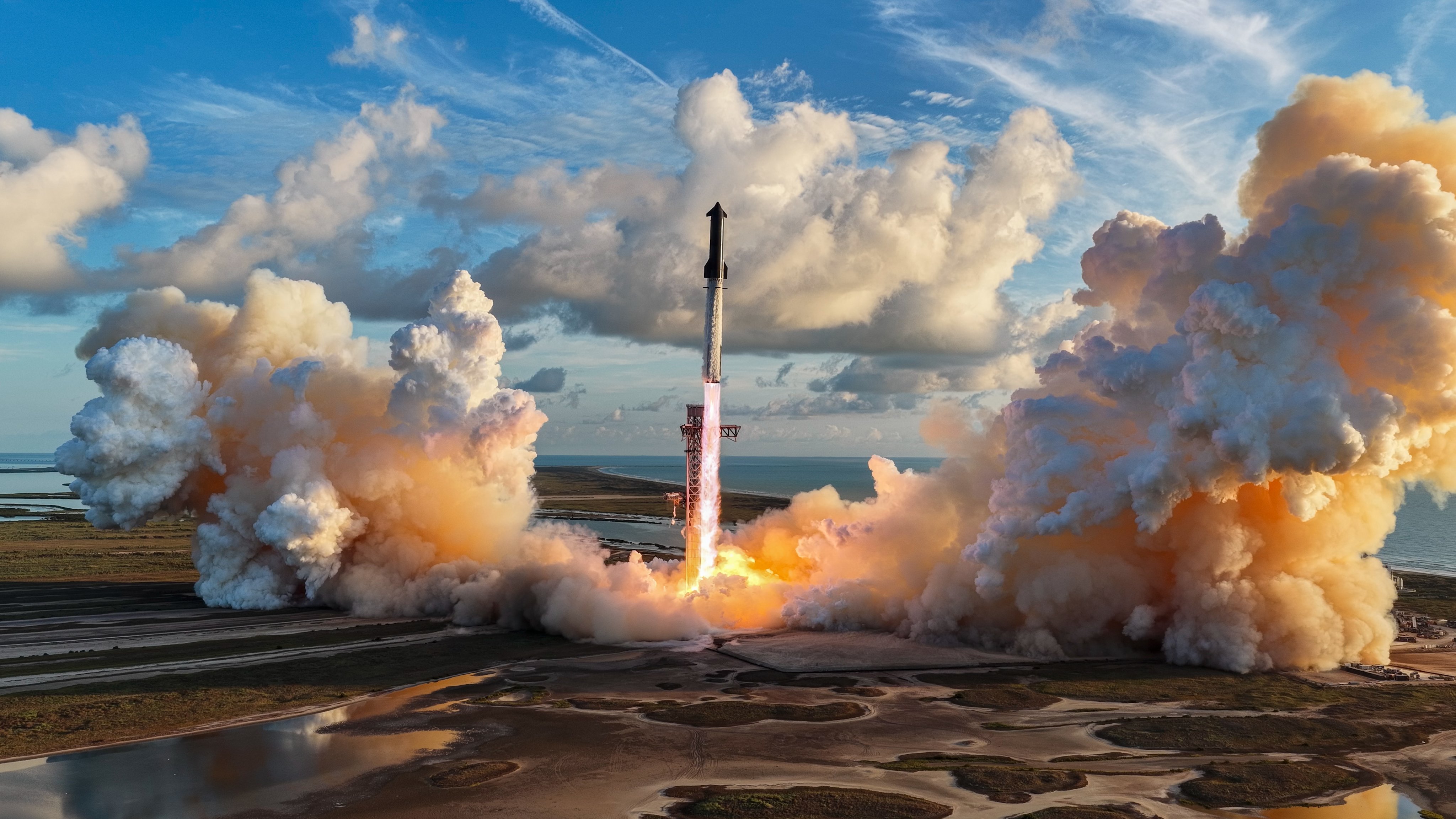
On Monday, September 28 at 7:48 a.m. CT, Starship lifted off from Starbase, Texas on its 14th flight and first attempt to go to orbit. This was the first orbital Starship flight and the first to deliver meaningful payload to orbit with 26 Starlink V3 satellites.
The mission began with the Super Heavy booster igniting all of its 33 Raptor 3 engines and ascending over the Gulf of America. During the initial climb to space, a single Raptor engine on the booster shutdown. The successful first-stage ascent was followed by a hot-staging maneuver and Starship’s upper stage igniting all six of its Raptor engines to continue onward to space.
Super Heavy performed its directional flip maneuver and relit 31 of the planned 33 Raptor engines for the boostback burn. The boostback maneuver on this flight was intentionally designed to burn through the remaining liquid oxygen inside the booster’s main tank to test the limits of booster performance ahead of future return to launch site missions. The booster then reignited 11 of the planned 13 engines for the high-thrust portion of the landing burn before down-selecting to five engines for trajectory fine-tuning, and then down to three engines before splashing down in the Gulf. Upon landing burn shutdown, the Super Heavy’s flight termination system was triggered in a demonstration of the safety hardware.
During Starship’s ascent burn, a single Raptor vacuum engine shut down early. Starship still achieved its planned, passively safe suborbital trajectory by burning its remaining five engines for longer than planned to compensate for the loss of thrust.
Premium keeps the launch-by-launch change log visible so you can review slips, window edits, and status changes without waiting for an error-driven upgrade prompt.
Free-to-share photography matched to this launch. Tap a photo to view it at full resolution.
Starship IFT patchMatched SpaceX launch-page assets and outbound media links for this launch.
14th test flight of the two-stage Starship launch vehicle. 3rd flight of Starship V3 and the first Starship flight to deploy satellites (a group of Starlink satellites known as Starlink Group 31-1) into stable Low Earth Orbit. The ship is expected to fly at an altitude approximately 275 km above Earth and complete approximately 6 orbits around the planet for nearly 10 hours, with splashdown targeted in the Pacific Ocean west of Chile. The booster’s primary test objective on Flight 14 will be executing a successful launch, ascent, stage separation, boostback burn, and landing burn at an offshore landing point in the Gulf. Starship will deliver 26 Starlink V3 satellites to orbit for the first time, which aim to greatly expand the network's capacity and user speeds. Each Starlink V3 satellite will add 1 Tbps of capacity to the constellation.

Alternate mission URLs consolidate to this canonical launch record so exact mission timing, status, media, and source context stay on one page.
Use these internal paths to move from this exact launch record into the provider, vehicle, launch-site, schedule, and mission-family pages that own broader context.
Some high-demand launch records carry specialized search intent. These profiles explain what can be verified from the published record without filling gaps that upstream sources have not published.
Flight-specific Starship record for schedule, status, vehicle, pad, source freshness, timeline, media, and the exact canonical launch detail.
Payload and orbit evidence is shown from published launch, payload, mission, and source-link records so the page can answer spacecraft, customer, orbit, provider, and schedule intent.
Deployment evidence is grouped from published launch, payload, orbit, program, agency, source-link, and status records so the page can answer constellation, spacecraft group, provider, orbit, and schedule intent without inventing unpublished manifest details.
Key structured fields for this launch record are grouped here so the page answers mission, payload, orbit, provider, source, and timing questions before the deeper tracking and media sections.
After entering its suborbital trajectory, the flight control team assessed Starship’s systems and determined the three sea-level Raptors engines needed for subsequent burns were healthy and gave a “go” for orbital operations. Starship then reignited a single Raptor sea-level engine to perform an orbit insertion burn and entered into orbit around Earth for the first time.
After a brief coast, Starship then deployed all 26 Starlink V3 satellites. Contact was made soon after with every satellite over laser links, ground stations, and Starlink user terminals. The satellites will now conduct on-orbit checkouts and raise their orbits before they begin serving customers.
Following payload deploy, Starship entered into a coast phase around Earth. Out of an abundance of caution given the engine issue experienced during ascent, the flight control team decided to limit the duration spent on orbit and proceeded with deorbiting Starship to a splashdown location in the northern Pacific Ocean. This area was one of two pre-coordinated landing zones identified before launch that was cleared of sea and air traffic.
Starship then relit a single Raptor sea-level engine and performed its first ever deorbit burn. That maneuver successfully brought the vehicle out of orbit and sent Starship through atmospheric reentry and descent to the intended splashdown point.
The first orbital Starship flight concluded with the vehicle relighting all three Raptor sea-level engines in a landing burn and flip maneuver before splashing down on target in the Pacific Ocean.
Premium unlocks this provider resource inside T-Minus Zero.
Stream links and embedded coverage.
Official WebcastOfficial SpaceX post matched to this launch.
Open the launch pad in Google Maps satellite mode using the pad coordinates.
14th test flight of the two-stage Starship launch vehicle. 3rd flight of Starship V3 and the first Starship flight to deploy satellites (a group of Starlink satellites known as Starlink Group 31-1) into stable Low Earth Orbit. The ship is expected to fly at an altitude approximately 275 km above Earth and complete approximately 6 orbits around the planet for nearly 10 hours, with splashdown targeted in the Pacific Ocean west of Chile. The booster’s primary test objective on Flight 14 will be executing a successful launch, ascent, stage separation, boostback burn, and landing burn at an offshore landing point in the Gulf. Starship will deliver 26 Starlink V3 satellites to orbit for the first time, which aim to greatly expand the network's capacity and user speeds. Each Starlink V3 satellite will add 1 Tbps of capacity to the constellation.

Third development version of the Starship reusable two-stage super heavy-lift launch vehicle.
All Times Approximate
Space Exploration Technologies Corp., known as SpaceX, is an American aerospace manufacturer and space transport services company headquartered in Hawthorne, California. It was founded in 2002 by entrepreneur Elon Musk with the goal of reducing space transportation costs and enabling the colonization of Mars. SpaceX operates from many pads, on the East Coast of the US they operate from SLC-40 at Cape Canaveral Space Force Station and historic LC-39A at Kennedy Space Center. They also operate from SLC-4E at Vandenberg Space Force Base, California, usually for polar launches. Another launch site is being developed at Boca Chica, Texas.
Launch-stage and landing context surfaced from LL2 when it exists.
Third V3 Starship to fly with various enhancements, to be used on the 14th Starship test flight, the first Starship flight to deploy satellites into stable Low Earth Orbit. Lost in an explosion just after the soft splashdown.
Linked via Spaceflight News API (SNAPI).
ArticleAlthough technical issues cut the mission short, Starship achieved most of its objectives, including its first deployment of an operational payload into orbit.
ArticleThe Super Heavy first stage booster, generating some 16 million pounds of thrust — twice the power of NASA's Space Launch System moon rocket — rapidly accele...
Ship 41 has performed a soft splashdown in the Pacific Ocean after deploying its payload.
Provider, rocket, pad, and booster history tied to this launch.
Core-level mission cadence associated with this launch.
Temporary flight restrictions and NOTAM matches tied to this launch.
Advisory data is informational. Confirm operational constraints with official FAA publications.
A launch-area reference planning index. Use your location for a viewpoint-specific result.
A broad, sunlit jellyfish-style plume is unlikely at the launch area under the current model. The rocket may still be visible as a point.
This is a planning index, not a percent chance. Higher means the modeled viewing setup is stronger.
If needed, your browser asks permission only after you choose this. The launch-area result is not a forecast for your viewpoint.
This score uses a modeled ascent corridor rather than an exact mission path. The overall viewing setup remains useful; direction and timing are approximate.
The setup is weak right now because multiple parts of the visibility chain are underperforming.
This outlook evaluates whether a broad, sunlit ascent plume could stand out. It does not yet predict whether a specific vehicle will produce one, and an unfavorable plume outlook does not mean the rocket itself will be invisible.
Read the jellyfish effect and JEP FAQ
Did you see a jellyfish-style plume from this viewpoint?