

Loading photos...
Loading mission resources...
Loading related events...
Loading vehicle timeline...
Loading related news...
TMinusZero
Loading
Preparing the latest launch data.
Launch Detail
Loading launch detail
Pulling launch timing, vehicle context, weather signals, and mission evidence.
Launch detail
United States Air Force • Thor Delta • Space Launch Complex 17A (FL)
Top answer
The Echo 1A spacecraft was a 30.48 m diameter balloon of mylar polyester film 0.0127 mm thick. The spacecraft was designed as a passive communications reflector for transcontinental and intercontinental telephone (voice), radio, and television signals. It had 107.9 MHz beacon transmitters for telemetry purposes. These transmitters were powered by five nickel-cadmium batteries that were charged by 70 solar cells mo...
Last refreshed: Jun 14, 2023, 1:40 PM EDT. T-Minus Zero keeps this as the canonical launch record and reconciles schedule, mission, payload, media, and provider signals when those records are available.
Alternate mission URLs consolidate to this canonical launch record so exact mission timing, status, media, and source context stay on one page.
Premium keeps the launch-by-launch change log visible so you can review slips, window edits, and status changes without waiting for an error-driven upgrade prompt.
Free-to-share photography matched to this launch. Tap a photo to view it at full resolution.
Enhanced forecast insights (select launches).
Premium adds the higher-signal weather shell for select Eastern Range launches, including the extra launch criteria and fast-read risk rows.
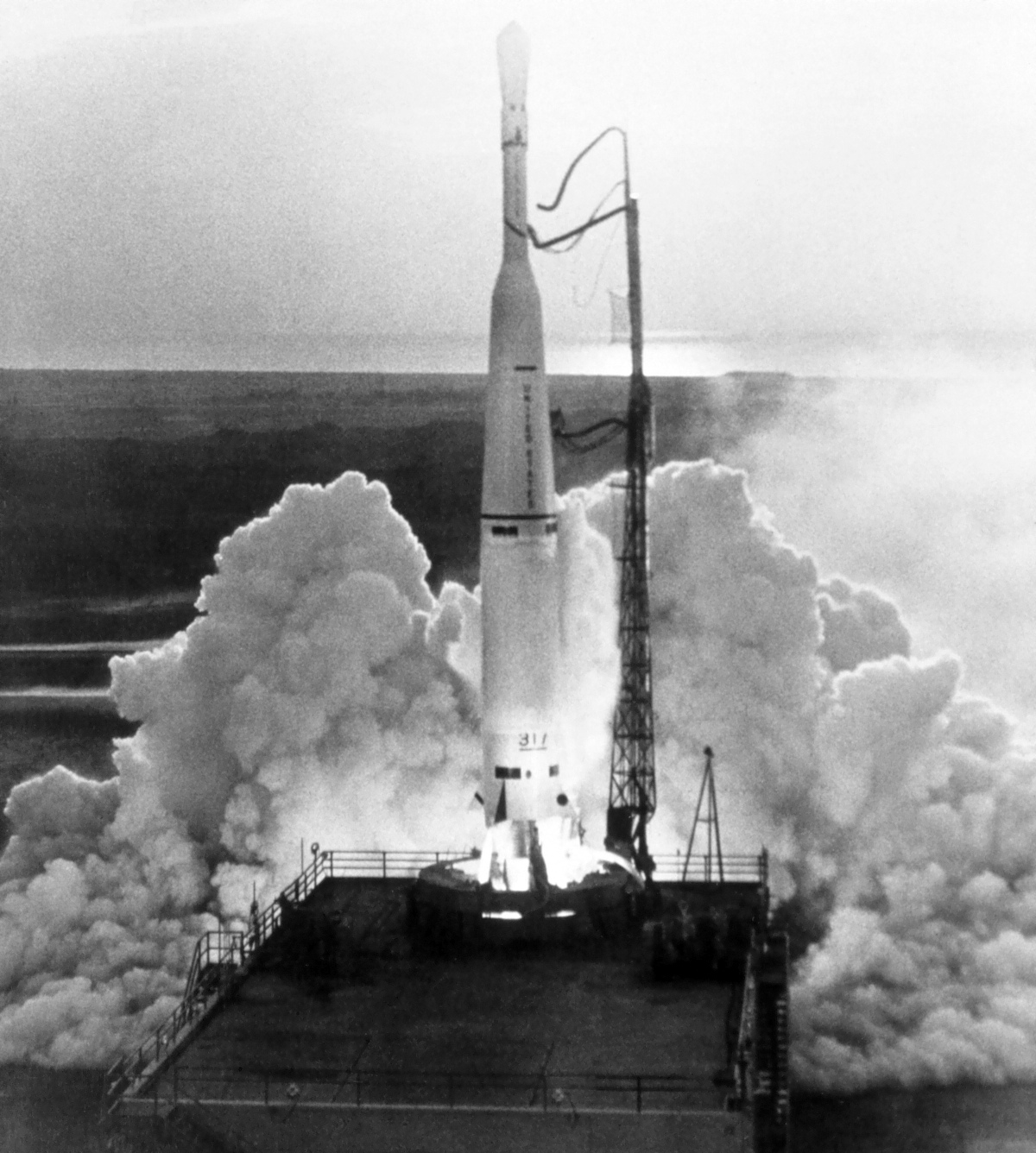
The Echo 1A spacecraft was a 30.48 m diameter balloon of mylar polyester film 0.0127 mm thick. The spacecraft was designed as a passive communications reflector for transcontinental and intercontinental telephone (voice), radio, and television signals. It had 107.9 MHz beacon transmitters for telemetry purposes. These transmitters were powered by five nickel-cadmium batteries that were charged by 70 solar cells mounted on the balloon. Because of the large area-to-mass ratio of the spacecraft, data for the calculation of atmospheric density and solar pressure could be acquired. The spacecraft was also used to evaluate the technical feasibility of satellite triangulation during the latter portion of its life. Echo 1 failed during the coast period after launch, as the attitude control jets on the second stage failed and the spacecraft did not achieve orbit. Echo 1A was a successful relaunch.
Use these internal paths to move from this exact launch record into the provider, vehicle, launch-site, schedule, and mission-family pages that own broader context.
This launch currently has no dedicated mission-family hub, so provider, vehicle, site, and canonical record links are the primary internal paths.
Some high-demand launch records carry specialized search intent. These profiles explain what can be verified from the published record without filling gaps that upstream sources have not published.
Payload and orbit evidence is shown from published launch, payload, mission, and source-link records so the page can answer spacecraft, customer, orbit, provider, and schedule intent.
Key structured fields for this launch record are grouped here so the page answers mission, payload, orbit, provider, source, and timing questions before the deeper tracking and media sections.
This record is preserved as historical launch context. The page emphasizes what was launched, the vehicle and pad involved, published outcome/status fields, linked programs, and source records instead of treating the mission like an upcoming countdown.
Open the launch pad in Google Maps satellite mode using the pad coordinates.
The Echo 1A spacecraft was a 30.48 m diameter balloon of mylar polyester film 0.0127 mm thick. The spacecraft was designed as a passive communications reflector for transcontinental and intercontinental telephone (voice), radio, and television signals. It had 107.9 MHz beacon transmitters for telemetry purposes. These transmitters were powered by five nickel-cadmium batteries that were charged by 70 solar cells mounted on the balloon. Because of the large area-to-mass ratio of the spacecraft, data for the calculation of atmospheric density and solar pressure could be acquired. The spacecraft was also used to evaluate the technical feasibility of satellite triangulation during the latter portion of its life. Echo 1 failed during the coast period after launch, as the attitude control jets on the second stage failed and the spacecraft did not achieve orbit. Echo 1A was a successful relaunch.
American orbital launch vehicle. Commercial name for the military's Thor-Delta.
The United States Air Force (USAF) is the air service branch of the United States Armed Forces, and is one of the eight uniformed services of the United States. Originally created on 1 August 1907, as a part of the United States Army Signal Corps, the USAF was established as a separate branch of the United States Armed Forces in 1947 with the enactment of the National Security Act of 1947.
8f8c84ea501794c36a71f7821dc751e99e7e7f34a280c1ed5bc4149d0593d3e0Provider, rocket, pad, and booster history tied to this launch.