
Story 2 of 7 · 5 min reading · 2–4 min exploring
How do you catch a rocket?
First, slow it down. Then let the tower take its weight.
From the archive · October 13, 2024
On October 13, 2024, SpaceX brought a Super Heavy booster back to its launch tower and caught it for the first time. Super Heavy is the lower stage of the Starship rocket system. It gives the upper spacecraft its initial push.
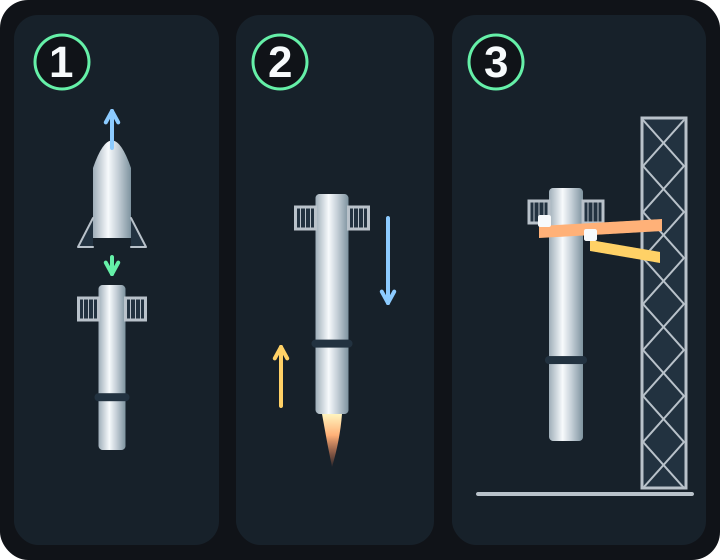
Three-part illustration. A pointed upper Starship separates from a long, blunt-topped Super Heavy booster. Next, the booster descends with engine thrust slowing it. Finally, the booster hangs beside a lattice tower, supported near its top by two arms, with no exhaust flame. This is a sequence of concepts, not engineering geometry.
1 · The upper Starship separates and continues its flight.
2 · The booster moves down while its engines push upward to slow it.
3 · Two tower arms support the booster near its top.
Two vehicles, two journeys
After the two stages separated on Flight 5, Booster 12 turned back toward the launch site. Ship 30, the upper spacecraft, continued on its own flight and later made a controlled splashdown in the Indian Ocean. No astronauts were aboard.
SpaceX uses the name Starship for both the full system and the upper spacecraft. The tower caught Super Heavy. Following those two vehicles separately makes the flight much easier to understand.
FROM THE MISSION
Starship's Fifth Flight Test
Mission footage · Flight 5 · October 13, 2024
What to notice
Watch the booster’s final descent beside the tower. Its engines slow it before the arms support its weight. Keep that return separate from the upper spacecraft’s flight.
Video: SpaceX
Super Heavy returns toward the tower, slows under engine power and settles onto the arms. The upper Starship follows a separate path and later splashes down in the Indian Ocean.
Original on SpaceX ↗ (opens in a new tab)First, get back to the tower
The booster used its engines to change its motion toward the return area. This is called a boostback burn: a period of engine firing that changes the return path.
During the descent, grid fins—lattice-like steering panels near the top—helped steer it through the air. Near the tower, the engines fired again to slow the descent. The booster had to arrive upright, in the right place and moving slowly. The tower arms were not a net stopping a rocket at full speed.
Then, hand over the weight
Two movable tower arms, nicknamed chopsticks, waited beside the descending booster. On the Flight 5 hardware, small structural fittings near the booster’s top met support beams on the arms. These support points had a different job from the grid fins used for steering.
As the booster settled onto the supports, the tower took its weight and the engines shut down. That handover is the moment shown in the final panel of our illustration. SpaceX said thousands of checks on the booster and launch site had to pass before a catch could go ahead.
Try it for yourself
Moving down, pushing up
The booster is moving downward while its engines push upward. How can both be true?
Open the Mission section. Find Booster 12’s return and Ship 30’s separate splashdown, then come back and compare the two journeys.
Follow Flight 5 in the mission recordWhat happened next?
The next flights had different endings. Flight 5 made the first catch on October 13, 2024. Flight 6 diverted its booster to the sea on November 19. Flight 7 made the second catch on January 16, 2025, although its upper spacecraft was lost. Flight 8 made the third catch on March 6, 2025; its upper spacecraft was also lost.
That is the early record: three tower catches through Flight 8. A catch, a sea diversion and the upper spacecraft’s outcome are different results. Each tells you something about the flight.
Recovery led to a further test on May 27, 2025: Flight 9 used the first Super Heavy booster to fly a second time. It was lost during its landing burn before a planned ocean splashdown. Flying again and returning again are separate achievements.
A return opens the door to another flight
Falcon boosters had already shown another way to return: landing on legs. Falcon Heavy’s two side boosters made a memorable pair of landings in February 2018. Super Heavy’s tower catch moved the support structure off the booster and onto the launch site.
Recovering the engines and structure creates the possibility of flying them again. Teams still need to inspect the hardware, understand its condition and prepare it. The remarkable ending is also the start of that next piece of work.
How has the catch hardware changed?
The hardware has continued to change. In its May 12, 2026 introduction of Starship V3, SpaceX described three larger grid fins, a revised catch point and shorter tower arms. Our illustration explains the original Flight 5 catch; it is not a drawing of every later version.
Three things to remember
- Super Heavy, the lower booster, came back to the tower.
- Its engines slowed the return before the arms supported it.
- Recovery is a step toward reuse, not an instant relaunch.
Keep exploring
Historical mission: March 6, 2025. Compare the booster recovery with the separate upper-ship outcome.
Historical mission: February 6, 2018. Its side boosters used landing legs.
Browse current and historical flights. Plans and outcomes belong to their own dates.
In the news
SpaceNews · Published
SpaceX launches fifth Starship, catches Super Heavy booster
Flight 5 combined two different milestones: Super Heavy returned to the launch tower, while the upper spacecraft completed a separate flight to an ocean splashdown. The catch made the booster’s return the most visible part of a much larger test.
Open mission and related coverage