
Story 3 of 7 · 5 min reading · 2–4 min exploring
Will I be able to see it?
The same launch can look very different from two places.
A viewing lesson · With a flight from February 6, 2018
A rocket leaves its launch pad and moves across the sky as it climbs. What you can see depends on where you are, where it is going and what is between you and it. Being closer does not guarantee a better view.
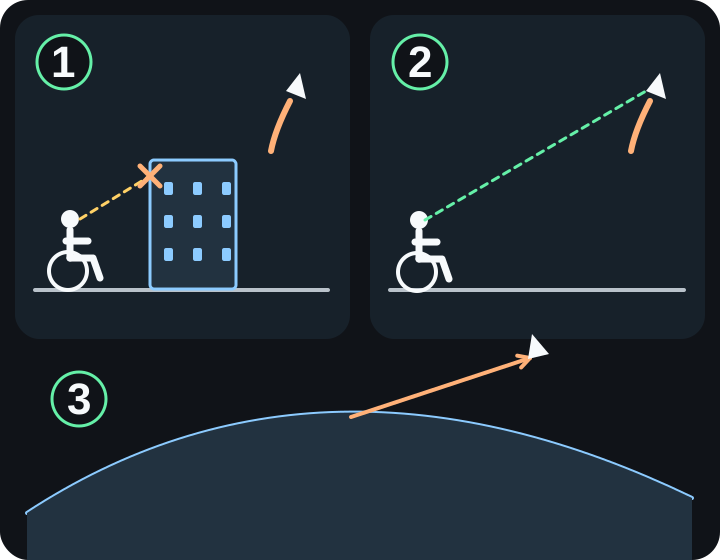
Conceptual visibility examples, not a flight map or a prediction for a particular location. Two seated observers face a rocket: a building blocks one sight line while the other is open. Below them, a curved horizon shows why the rocket’s height and path affect when it comes into view.
1 · A building blocks one observer’s line of sight.
2 · An open horizon leaves the other observer’s view clear.
3 · The rocket climbs and travels away from its pad.
Two people, one launch
Imagine two people watching the same rocket. One has an open horizon. The other looks toward a building. Both face the launch site, but only one has a clear view ahead. Distance from the pad is just one part of the answer.
Your horizon is where the ground seems to meet the sky. Elevation is the angle between that horizon and the object you are looking at. It describes where the rocket appears in your sky, rather than its height above the ground.
FROM THE MISSION
Falcon Heavy Test Flight
Archived broadcast · First Falcon Heavy flight · February 6, 2018
What to notice
When the camera changes, identify the vehicle and the part of the flight. Is the camera on the ground or aboard a vehicle? If its location is not identified, leave that detail unknown.
Video: SpaceX
Falcon Heavy lifts off with three booster cores side by side. Broadcast cameras switch between the climb and the two side boosters returning to nearby landing zones. The center core’s separate recovery attempt did not succeed.
Original on SpaceX ↗ (opens in a new tab)The rocket keeps moving
As the rocket climbs, it may clear the building in one observer’s view. Then it travels away from the pad in the direction its mission needs. A useful direction for the first moments of flight may not describe where to look later.
Earth’s curve can hide a distant rocket during the low part of its flight, even across an otherwise open horizon. The lower panel in the illustration shows that relationship. Both people in the upper panels are seated; in that example, the building is what blocks the view.
Try it for yourself
Compare the two views
Who might see the early climb? What could change as the rocket climbs higher?
01
An open horizon
This observer has a clear line of sight toward the launch. Clouds, haze and the rocket’s path still affect what becomes visible.
02
A building in the way
This observer faces the same launch, but a building blocks the low part of the sky. The rocket may later rise above the roof in this person’s view.
Open the Mission section of Falcon Heavy’s first flight. Identify the launch site and the two side-booster landings; notice that launch and recovery happened in different places.
Explore a launch with several viewpointsThe atmosphere gets a say
An open view can still contain cloud or haze. Low clouds may hide the early climb; another layer can obscure the rocket farther along its path. Bright daylight can make a small, distant object harder to pick out.
A visible rocket and a glowing jellyfish plume are different sights. The plume also needs the right sunlight. JEP calls whether the plume can be seen; it is not a general rating for every part of a launch.
A broadcast can be in several places
A broadcast borrows views from several places. It can follow parts of a mission that one person on the ground could never see together.
On February 6, 2018, Falcon Heavy launched for the first time. Its two side boosters returned to landing pads, while the center core’s separate recovery attempt at sea did not succeed. The Tesla Roadster test payload continued into an orbit around the Sun. Starman, seated inside it, was a mannequin.
A broadcast could switch among the rising rocket, the departing payload and the returning boosters. Those cameras showed different places and different vehicles. One observer on the ground could not simply share every camera’s viewpoint.
Describe the view you mean
Try this sentence: “From this viewpoint, this part of the flight may be visible because…” Perhaps the horizon is open, the rocket has climbed high enough, or a sunlit plume stands out against a dark sky.
Then add what might change the view. For an upcoming flight, start with its date, time zone and status, and check the viewing information again near launch. If an estimate is unavailable, the view is still unknown.
Three things to remember
- Check where the launch is and which way the flight goes.
- An open horizon, clouds and daylight affect what you can see.
- A launch and a booster landing may need different views.
Keep exploring
See why a visible rocket does not guarantee a glowing plume.
In the iPhone app, choose a future mission in Today. Check its place, time zone and status.
See the rocket’s three-core arrangement and other missions.
In the news
Teslarati · Published
SpaceX Falcon Heavy rocket celebrates 4th launch debut anniversary
Falcon Heavy’s debut paired a successful test launch with two side-by-side booster landings. The center core was not recovered. The Roadster payload followed a separate journey into orbit around the Sun.
Open mission and related coverage