
Story 5 of 7 · 5 min reading · 2–4 min exploring
Around the Moon, with people aboard
The rocket starts the journey. The spacecraft brings a small home along.
A 2026 milestone · April 1–10, 2026
Four people left Earth aboard Orion on April 1, 2026. Artemis II carried them around the Moon and home again, to a Pacific Ocean splashdown on April 10. At their farthest, they were 252,756 miles from home, farther from Earth than anyone had ever traveled. They flew around the Moon without landing.
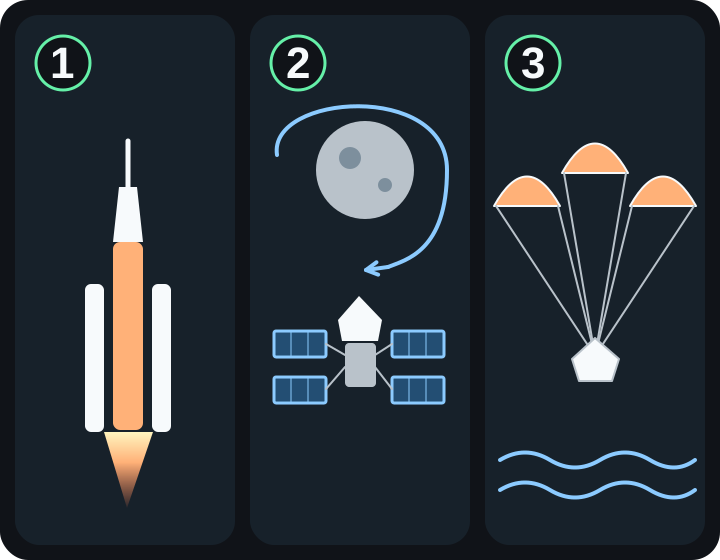
A three-part storyboard rather than an orbital map. First, a rocket launches an Orion spacecraft. Second, Orion’s capsule and service module with four solar-panel wings pass by the Moon. Third, only the crew capsule descends beneath three main parachutes toward the ocean. No Moon landing is shown; sizes and distances are not to scale.
1 · SLS launches the crew in Orion.
2 · Orion carries the crew on a flyby around the Moon.
3 · The crew capsule returns to Earth and splashes down.
A home for four, far from Earth
Commander Reid Wiseman, pilot Victor Glover, and mission specialists Christina Koch and Jeremy Hansen traveled in the Orion spacecraft named Integrity. Wiseman, Glover and Koch represented NASA. Hansen, from the Canadian Space Agency, became the first Canadian to fly around the Moon.
The crew needed somewhere to breathe, drink, eat, sleep and work. They also needed to steer, communicate and get home. For the rest of the journey, Orion had to support familiar routines in an unfamiliar place.
FROM THE MISSION
Welcome Home, Artemis II (Official NASA Recap)
Postflight recap · Artemis II · April 1–10, 2026
What to notice
Start with the four people walking together. Then connect their journey with the spacecraft systems below: a place to live and work, and a capsule built to bring them home.
Video: NASA
NASA looks back at four astronauts launching aboard Orion, traveling around the Moon and returning to a Pacific Ocean splashdown. This is a recap of the completed April 2026 flight.
Original on NASA ↗ (opens in a new tab)The rocket starts the journey
The Space Launch System, or SLS, launched Orion. The spacecraft then continued with two main parts: the crew module, where the astronauts lived, and the European Service Module, which supplied power, water, air supplies, temperature control and propulsion.
The European Space Agency provided the service module. Four solar-array wings collected sunlight to make electricity. Engines adjusted Orion’s path and orientation. Tanks supplied drinking water, oxygen and nitrogen to the crew module.
Follow one breath
Breathing in uses oxygen; breathing out adds carbon dioxide to the cabin. Supplying fresh oxygen is only half the problem. Orion’s cabin systems also remove carbon dioxide and circulate the air.
People and equipment give off heat, and breathing adds moisture. Managing temperature and humidity matters alongside keeping the right air pressure. A drink of water and a comfortable breath depend on systems working together throughout the journey.
Try it for yourself
Is the cabin ready?
In this imagined cabin check, oxygen is at its normal level but carbon dioxide is rising. What would you need to check before calling the cabin ready?
Open the Artemis II Mission section. Find the four crew members and Orion, then connect their journey with the living systems explained here.
Meet the crew on their mission pageLiving aboard was part of the test
On April 2, 2026, NASA reported that the Artemis II crew had begun their first exercise sessions inside Orion. Their compact flywheel resisted a pulled cable, supporting movements such as rowing and squats. Even on a journey around the Moon, the day included making time to stay healthy.
During the workouts, ground teams watched the cabin-air system and checked how the astronauts’ movements affected Orion. Exercise tested more than the crew’s muscles: it helped teams learn how their small spacecraft worked with people living inside.
Engineers, flight controllers, medical teams, trainers and recovery crews supported the journey. Teams on Earth monitored the spacecraft and helped the crew throughout the flight.
Only the crew module comes home
Before entering Earth’s atmosphere, Orion’s crew module separated from the service module. The crew module’s heat shield protected the cabin as the atmosphere slowed the spacecraft. Later, parachutes reduced its speed for splashdown.
The final panel shows the capsule beneath its three main parachutes. The rocket and service module are no longer attached. Returning safely required a sequence of systems, with recovery teams waiting at the end.
The journey returns to the team
On September 1, 2026, the four astronauts visited NASA’s Marshall Space Flight Center. NASA’s September 9 account described them sharing their experiences with people who had supported Artemis II.
A lunar journey is easy to picture as four people in a capsule. That visit brings the larger group into view: the people who built, tested and supported the systems those astronauts lived with.
Three things to remember
- SLS launched the mission; Orion carried the four astronauts.
- The crew flew around the Moon without landing on it.
- Keeping people alive means managing air, water, heat and moisture throughout the journey.
Keep exploring
Demo-2 used Falcon 9 and Crew Dragon for a different destination and mission.
See Space Launch System Block 1 and its mission records.
In the news
NASA · Published
Artemis II Crew at NASA Marshall
The four Artemis II astronauts visited Marshall Space Flight Center on September 1, 2026. They shared their flight experiences with members of the team that helped prepare and support their journey around the Moon.
Open mission and related coverage