
Story 4 of 7 · 5 min reading · 2–4 min exploring
How does Webb fit?
A giant telescope, folded for the ride.
From the archive · December 25, 2021
The James Webb Space Telescope—Webb for short—was too large to launch in its working shape. Its mirror wings folded back and its sunshield packed away for the ride. An Ariane 5 launched it from French Guiana on December 25, 2021.
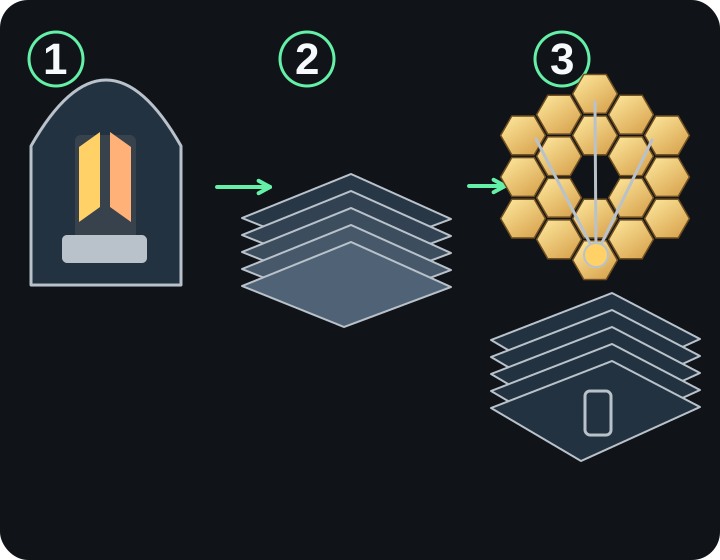
Three-part illustration. A compact telescope sits within an outline of its protective fairing. Next, five separate sunshield layers spread out. Finally, the main mirror is shown with 18 hexagonal segments around a central opening, a smaller secondary mirror supported in front, and five sunshield layers below. This is a simplified deployment sequence.
1 · The mirror wings and sunshield fit into a compact launch package.
2 · The five sunshield layers open beneath the telescope.
3 · Both mirror wings open to complete the 18-segment main mirror.
A large telescope, a limited space
Webb was designed to collect faint infrared light, which human eyes cannot see. A large mirror gathers more light. Making the telescope small enough to fit easily inside a rocket would have changed what it could observe.
The fairing is the protective cover around the payload during launch. Webb had to fit inside Ariane 5’s fairing, then take on a much larger shape in space. Engineers built the change of shape into the telescope itself.
FROM THE MISSION
Webb launch campaign highlights
Launch preparation footage · Webb · December 2021
What to notice
Watch how Webb is prepared for launch, then compare its compact shape with the unfolded telescope in our illustration.
Video: ESA/CNES/Arianespace
ESA’s launch-campaign footage follows preparations for Webb’s departure from French Guiana. The observatory had to travel inside Ariane 5’s protective fairing in its compact launch configuration.
Original on ESA ↗ (opens in a new tab)A mirror with wings
Webb’s main mirror has 18 hexagonal segments. Two side wings each hold three segments. Those wings folded back for launch and opened later to complete the light-collecting surface.
The smaller secondary mirror sits in front of the main mirror on supports and directs light toward the instruments. Once the hardware opened, the team still had to align the mirror segments so their light could form a sharp image.
Keeping the telescope cold
Warm objects give off infrared radiation. That includes the telescope itself. To measure faint signals from space, Webb needs to control the heat reaching its mirrors and instruments.
Its five-layer sunshield helps keep the telescope side cold while the other side faces the Sun, Earth and Moon. The layers are thin sheets with gaps between them, allowing heat to escape. Our illustration spreads the layers apart so you can see how they are arranged.
Opening was a sequence, not a single switch
Webb’s sunshield deployment was completed on January 4, 2022. The last main-mirror wing opened on January 8. Cooling, mirror alignment and instrument checks continued after the major pieces were in place.
The illustration follows that broad sequence: packed for launch, sunshield open, mirror open. It shows the shapes involved, rather than every release and movement needed to get from one to the next.
Try it for yourself
How would you make it fit?
You want a large telescope in space, but its working shape will not fit inside the rocket. Choose an approach and see what it changes.
Open the Mission section and find Webb as the payload. Compare the compact observatory in the launch footage with the open telescope in our illustration.
See what Ariane 5 carriedWhat all that unfolding made possible
In a September 15, 2026 update, NASA described Webb’s view of IC 348, a region where stars form. Researchers identified the least massive brown dwarfs known, some only about twice the mass of Jupiter. Brown dwarfs form like stars but cannot sustain the hydrogen fusion that powers ordinary stars.
Images helped researchers find candidates. Follow-up measurements that split their light into a spectrum helped estimate their masses. The image alone does not establish an object’s mass.
Those faint objects help researchers explore how small a star-like object can be. The large mirror and cold infrared instruments made that investigation possible. The folding problem at launch was part of reaching this much larger scientific question.
FROM THE MISSION
What the folded telescope went on to see
Telescope image · infrared data shown in visible colors · released September 15, 2026
What to notice
Follow the bright clouds toward the dark opening on the right. In the upper right, look for narrow jets of material streaming from young stars. This view is part of the scientific reward for unfolding a large, cold telescope in space.

Image: NASA, ESA, CSA, Kevin Luhman (PSU), Catarina Alves de Oliveira (ESA), Mahdi Zamani (ESA/Webb)
Webb’s camera recorded infrared light from IC 348, a region where stars form. Different infrared measurements are shown in blue, green and red so we can see their differences. These are colors assigned to telescope data, rather than the view human eyes would have in space.
Original on NASA ↗ (opens in a new tab)Three things to remember
- The rocket carried Webb folded inside its protective fairing.
- The sunshield and mirror wings opened after launch.
- The sunshield helps keep Webb cold so it can study faint infrared light.
Keep exploring
Use the same rocket–payload–purpose questions with another mission.
Explore Ariane 5 and its launch history.
In the news
NASA · Published
NASA’s Webb Reveals Dynamic Panorama of Star Formation
Webb’s infrared view of IC 348 reveals young stars, dusty material and very faint brown dwarfs. Some have estimated masses around twice Jupiter’s. The observations help researchers investigate how low-mass objects form.
Open mission and related coverage