
Story 1 of 7 · 5 min reading · 2–4 min exploring
What makes a rocket plume glow?
The rocket looks tiny beside its glowing plume.
A launch you can see in a new way
A plume is the cloud of exhaust a rocket leaves behind. High above the ground, that cloud can still catch sunlight when the people watching are already in darkness. Against the dark sky, the lit cloud may look like a huge jellyfish.
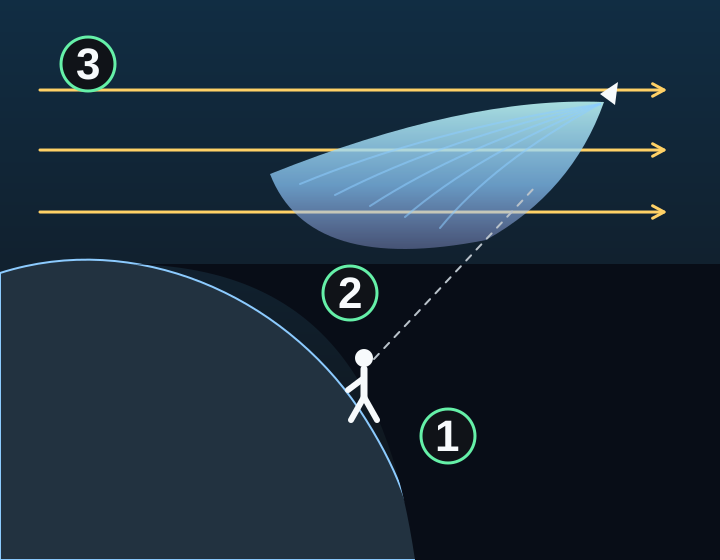
Side-view diagram, not to scale. Sunlight travels from left to right above the curved ground. An observer is in shadow on the right. A rocket’s expanding plume is above that shadow and receives sunlight. The small rocket sits at the narrow end of the plume.
1 · An observer stands on the dark side of the curved ground.
2 · High exhaust catches the sunlight and spreads out.
3 · Sunlight travels past the ground’s shadow to the plume.
A bright point becomes a cloud
The bright moving point in a launch video is only part of the story. Hot exhaust streams out of the engines. Higher up, the surrounding air presses on it less, so it can spread into a broad plume. Fresh exhaust joins the cloud while older material drifts and expands.
The engine exhaust can shine on its own. The huge, pale cloud people call a rocket jellyfish gets its broad glow from sunlight scattered toward the viewer. That is why the sky can fill with light long after the rocket looks like a tiny point.
FROM THE MISSION
A rocket jellyfish before sunrise
Mission photograph · CRS-15 · June 29, 2018
What to notice
Start at the dark coast, then look up at the broad glow and the curling trail above it. The Sun has not risen for people on the ground, but its light already reaches the exhaust high overhead.

Photo: SpaceX
Sunlight catches Falcon 9’s spreading exhaust high above Florida during the CRS-15 launch on June 29, 2018. Below the glowing plume, the coast is still dark. The rocket was carrying a Dragon cargo spacecraft to the International Space Station.
Original on SpaceX ↗ (opens in a new tab)Dark on the ground, sunlit overhead
Earth is curved. Around sunset, your part of the ground turns into shadow before everything high above it does. A rocket plume can still have a clear view of the Sun after the Sun has disappeared from your horizon. The reverse can happen before sunrise.
This works best when the sky behind the plume is dark enough for the cloud to stand out. Later at night, that part of the flight may enter Earth’s shadow too. Where the rocket goes and when it gets there both matter.
One plume, different views
One observer may have a clear view while another has cloud, haze or a building in the way. The plume’s appearance also changes as the rocket moves. A camera can collect more light than your eyes, and its exposure and processing can bring out faint color.
A spiral seen later in a mission can have a different cause, such as a rotating upper stage releasing material. The jellyfish in this lesson is the spreading exhaust cloud during ascent.
Try it for yourself
What changes the glow?
Both observers are in darkness. What changes between the pictures—and why does that change the plume’s appearance?
01
View A · sunlight reaches the plume
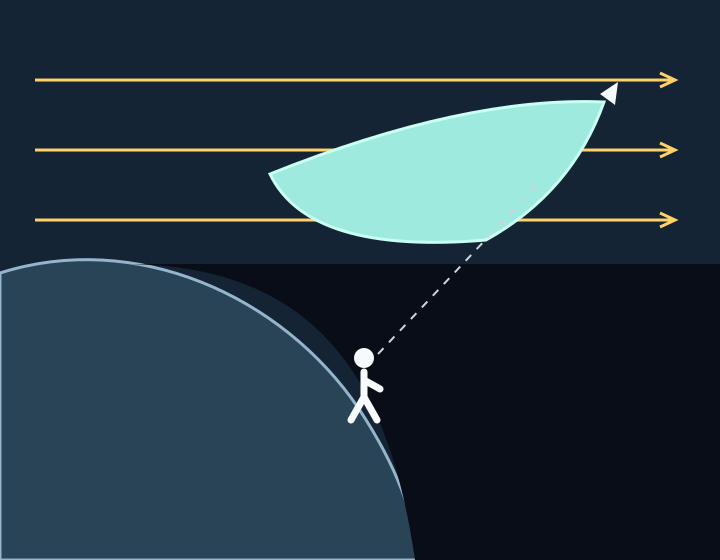
The observer is in darkness. Higher up, sunlight reaches the spreading exhaust. This is a simplified lighting example, not a forecast.
02
View B · the plume is in shadow
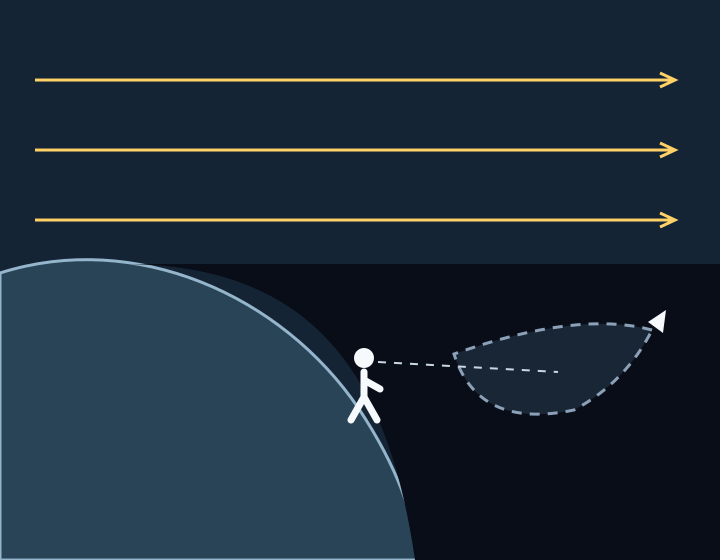
The observer is still in darkness, but the exhaust is inside Earth’s shadow too. The engine flame may still shine; the broad cloud has no direct sunlight to scatter. The outline shows where the exhaust is; it does not represent a visible glow.
Read a JEP result · fictional teaching example
- Jellyfish launch
- Likely
- Reason
- Good chance to see it at the launch site
- Viewpoint
- Launch-area reference
- Model confidence
- Medium
- Weather basis
- Weather included
JEP means Jellyfish Exposure Potential: a call of Likely, Possible or Not expected on whether a sunlit plume can be seen from a place, with one line naming the main reason. In this fictional example, the sunlit plume, the dark sky and the view above the horizon line up well at the launch area. It is not a forecast for your home, and Likely is not a promise of seeing a plume. The place and confidence are part of the answer.
In the guide, read “A call belongs to a place” to understand which viewpoint a result describes. No location permission is needed to read the guide.
Read the full JEP guideWhat to check before watching
Before following a live launch, check the latest time and which location the estimate describes. A delay can change the light, so an earlier call may no longer describe the flight.
Three things to remember
- Sunlight can reach high exhaust while the ground below is dark.
- The exhaust spreads out in thinner air, making a broad plume.
- Twilight helps, but it does not guarantee a visible jellyfish.
Keep exploring
In the iPhone app, choose a mission in Today. Check its date, time zone and current status.
Compare clear and blocked horizons without sharing your location.
Explore the rocket behind many familiar twilight launch photographs.